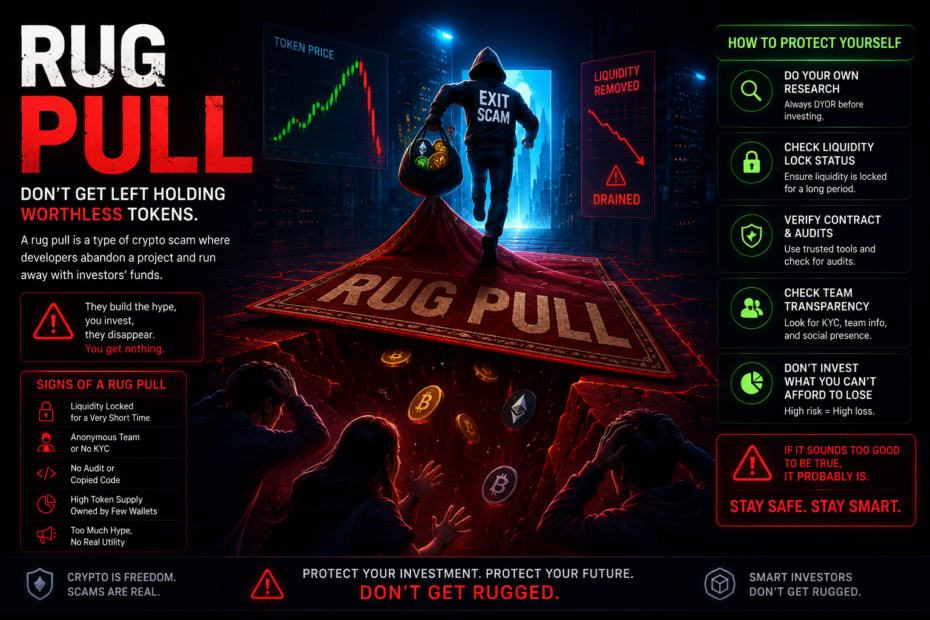
Understanding Crypto Rug Pulls: Definition, Cases & Prevention
Meta: Learn what crypto rug pulls are, how scammers execute them (liquidity drains, honeypots, fake audits, social tactics), plus real case studies, red flags, legal context, and how to protect your funds.
Executive Summary
Crypto rug pulls – a type of exit scam unique to the crypto world – have become the single biggest threat in DeFi, accounting for over 50% of new crypto scam incidents【4†L71-L80】. In a rug pull, project developers or insiders abruptly withdraw liquidity or abandon the project, leaving investors with worthless tokens【7†L150-L157】【10†L181-L189】. This article defines rug pulls and their common forms (liquidity drains, honeypots, admin-key exits, social-engineered scams), provides recent case studies (such as the Red Kitten Crew token and Luna Yield) with dates and losses, and lists warning signs to spot and avoid them【23†L71-L80】【26†L122-L125】. We also review practical prevention steps (due diligence, audits, multisigs, timelocks, locked liquidity, wallet safety) and discuss legal/regulatory aspects. By understanding typical rug pull mechanics and red flags (anonymous teams, unlocked liquidity, no audit, hype without fundamentals【12†L241-L249】【12†L252-L259】), readers can make more informed decisions.
What Is a Rug Pull?
A rug pull is a crypto exit scam where a project’s creators suddenly withdraw funds or liquidity and disappear, crashing the token’s price and leaving investors with worthless assets【7†L150-L157】【12†L297-L304】. It’s like being invited to split a dinner bill and watching the host vanish with your money. Rug pulls exploit the decentralised nature of crypto: developers often create new tokens on exchanges, encourage others to buy, then “pull the rug” by draining liquidity pools or using hidden contract functions. Unlike traditional pump-and-dump schemes, rug pulls typically use smart-contract tricks specific to DeFi【1†L162-L170】【10†L181-L189】.
Rug pulls can be technical (built into the code) or social/marketing-based. Technical scams may include honeypot contracts (buyers can’t sell) or hidden mint functions (unlimited token printing) that crash prices. Non-technical pulls rely on hype – for example, building a large social media following or faking partnerships – then the team abandons the project after collecting investments【10†L222-L230】【7†L161-L170】. In practice, many scams use both: malicious code plus aggressive marketing. (For example, the 2021 “Squid Game” token was programmed to block sells and was heavily marketed, netting its creators over $3 million in days【7†L170-L174】.)
Common Rug Pull Mechanisms
Rug pulls typically follow a predictable pattern. Here’s a simplified flowchart of a classic rug pull lifecycle:
flowchart LR
A[Project Launch (Token & Liquidity Pool)] –> B[Marketing & Hype (Social media buzz, influencer endorsements)]
B –> C[Investor Buying (Token price rises, liquidity pool grows)]
C –> D[Developer Trigger: Withdraw Liquidity or Activate Code]
D –> E[Token Dump: Liquidity drained or selling disabled]
E –> F[Price Crash: Investors cannot sell; token worthless]
- Liquidity drain (“liquidity rug”) – The most common type. On a DEX, new tokens must be paired with a base asset (ETH/USDT, etc.) in a liquidity pool. After launch, early buyers drive up the price by adding funds. Then the developers use their LP tokens to withdraw all (or most) of the pooled base asset【10†L187-L197】【29†L147-L156】. This collapse leaves the token trading at near-zero value since there is no liquidity left for others to sell into. Developers may control the LP tokens themselves (no lock or multisig), allowing them to pull the funds at any time【10†L193-L200】【19†L60-L69】. For example, a 2026 incident saw a memecoin (RKC) crash 90% after devs drained ~$600K in liquidity in hours【23†L71-L80】.
- Honeypots and hidden code – In a honeypot scam, the smart contract itself is rigged so that buying works but selling is blocked. The contract may include hidden functions or conditions (e.g. a 100% sell tax, or an “owner-only” transfer function) that prevent holders from exiting【10†L204-L212】【29†L176-L184】. Thus the token price can be inflated while the scammer sells out, but legitimate users become trapped. (The infamous Squid Game token was one such honeypot: buyers could not sell, while the creators cashed out the hype【7†L170-L174】.) Other malicious code tricks include hidden mints (owner can create unlimited tokens, diluting others) and backdoor transfers (owner can steal tokens from user wallets)【10†L204-L211】【29†L162-L171】.
- Admin-key exploits (governance breaches) – Some scams exploit centralized control. A project might allow an “admin” or owner key to change contract logic or withdraw funds. If the admin’s private key is compromised (by hack or insider), the attacker can upgrade contracts or drain vaults【19†L59-L67】【19†L81-L90】. Even without a hack, a single dev could use an exposed owner role to vault funds to a mixer (as in Luna Yield) or deploy malicious upgrades【26†L122-L125】【19†L87-L94】. Recent DeFi breaches (Wasabi, Drift, Kelp DAO) all used compromised admin keys to pull funds from vaults, often highlighting the lack of timelocks or multisig protections【19†L59-L68】【19†L102-L110】.
- Fake audits and impersonation – Scammers often use social engineering: publishing bogus audit reports or impersonating reputable firms to seem credible. A team might claim a “security audit” from a known company when none exists, or use copycat logos. Similar deception includes cloning real project websites or announcing fake partnerships. These tactics lull investors into a false sense of safety. For instance, many victims only realized too late that an “auditor” was a sham【12†L245-L250】【29†L207-L215】. Always verify audit links directly on the auditor’s site and ensure it matches the audited contract address.
- Social/Influencer rug pulls – Here, hype drives the scam more than code. The project may launch an ordinary token or even a legitimate-looking product, but once enough people commit funds, the team vanishes with the money. This can happen via celebrity endorsements, viral social posts, or flashy memes. A classic example is the 2026 Red Kitten Crew (RKC) memecoin: a popular trader’s Twitter account promoted the token, prices soared, then the post was deleted and within hours the coin crashed as the (possibly compromised) dev cashed out ~90% of its value【23†L71-L80】【23†L91-L99】. Similarly, influencer-backed memecoins like $HAWK (late 2024) skyrocketed with celebrity promotion, only to plummet 90% when insiders dumped supply【26†L186-L195】. These “social” rugs are especially insidious because they rely on trust and hype, not necessarily malicious code – making them harder to spot until it’s too late.
Notable Case Studies
| Project | Date | Type of Rug Pull | Mechanism | Impact / Losses | Key Lesson |
| Red Kitten Crew (RKC) – Solana meme coin【23†L71-L80】 | May 2026 | Social/Influencer | Influencer tweet hype; dev withdrew liquidity | Devs cashed out ~$611K (plus $118K fees), 90% price crash【23†L71-L80】 | Celebrity hype can be faked or hacked; large early supply is risky. Verify hype sources. |
| Luna Yield (LUNY) – Solana DeFi platform【26†L122-L125】 | Mar 2021 | Liquidity/Exit | IDO raised funds; all funds sent to mixer (Tornado Cash) | ~$6.7 million stolen【26†L122-L125】 | Even “professional” projects with partners can rug; lack of transparency hides true intent. |
| $SQUID (Squid Game token) – Binance Smart Chain【7†L170-L174】 | Oct 2021 | Honeypot | Smart contract blocked sells (honeypot exploit) + marketing site | Founders netted over $3 million【7†L170-L174】 | Code can hide traps: unchecked token should be approached with skepticism, even if hype is real. |
| Wasabi Protocol – Ethereum/Base perpetuals【19†L59-L67】 | Apr 2026 | Admin-Key Exploit | Attacker obtained deployer private key; granted itself admin privileges, upgraded contracts; drained multiple pools | ~$4.55 million drained【19†L59-L67】 | Single private key control is dangerous: no timelock or multisig meant attackers withdrew funds unchecked. |
| Bored Bunny (NFT) – Ethereum NFT project【15†L83-L92】 | Dec 2021 | Social/Insider | NFT sales; founder-owned wallets traded/scaled hype | ~$4 million raised (1,111 NFTs sold); floor price collapsed to near zero【15†L83-L92】 | Check blockchain data: insider ownership and transfers reveal if “celebrity” endorsements are real or faked. |
Each of these cases illustrates a lesson: tokenomics and team actions should be transparent, and hype alone is not an audit. Notably, RKC shows how influencer endorsements can trigger rapid 24-hour crashes【23†L71-L80】, and Luna Yield highlights that even well-partnered projects can secretly siphon funds within days【26†L122-L125】. The Wasabi hack underscores the need for multisig/timelock (a single key allowed instant theft)【19†L59-L67】【19†L102-L110】.
Indicators and Red Flags
While any single sign isn’t definitive proof of a scam, several together warrant extreme caution:
- Anonymous or pseudonymous team. No verifiable identity or background for founders makes accountability impossible. Rug-pull scams thrive when developers can simply vanish with funds【12†L241-L249】.
- No or fake audit. Absence of a formal smart-contract audit is a red flag. Even if an audit is advertised, ensure it’s from a reputable firm and covers the current code【12†L245-L250】. Fake audit certificates or audits by unknown firms are common tricks.
- Unlocked or burnable liquidity. Check if the project’s liquidity pool tokens are locked (often via a time-lock service) or if an admin key can drain them. Projects that allow LP to be withdrawn at any time have a clear exit path. Many legitimate projects lock liquidity to demonstrate commitment【12†L252-L259】【10†L193-L201】.
- Unrealistic promises and hype. Be wary of guaranteed returns, celebrity endorsements without proof, or aggressive FOMO marketing. If a token promises 100× gains or rapid riches, it usually reflects desperation or deceit【12†L259-L262】【15†L147-L155】.
- Major token concentration. Examine token distribution using a block explorer. If a few wallets (often the founders’) hold a very large share of supply, they can dump it any time. In $HAWK’s case, insiders held ~95% of tokens, enabling the crash【26†L186-L194】.
- Suspicious contract code. Anyone with technical skill can inspect the token contract. Warning signs include functions like mint(), tax(uint), transferFrom(address,address,uint) that only an owner can call, or missing onlyOwner renouncement. Tools like Etherscan or SolScan show if the code is verified (open source) and who the owner is.
- High token listing prices with thin liquidity. If a token’s price skyrockets on tiny buy volume (often via buy bots or small trades), it’s possibly an artificial pump. True demand usually requires substantial volume; if prices move on micro-buys, insiders may be manipulating the book.
Platforms like token trackers (e.g. CoinGecko, CoinMarketCap) or tools like TokenSniffer/RugDoc can flag many common tricks. However, they aren’t foolproof – ultimate caution comes from manually checking sources.
Prevention and Mitigation Strategies
While no method guarantees safety, the following steps greatly reduce risk for users and projects:
- Do Your Own Research (DYOR). Always read beyond marketing. Study the whitepaper, check developer identities, review tokenomics and roadmap. Use a block explorer (Etherscan, SolScan, etc.) to inspect the smart contract’s owner address and transaction history【12†L269-L277】. Verify that ownership is renounced or locked, and that token code matches what auditors approved.
- Check audit reports carefully. Only trust audits listed on the auditor’s official site. Audits should not only exist, but be current (covering the latest code). Be cautious if an audit is not publicly accessible. Even with an audit, look at the firm’s reputation; firms with a history of catching scams (e.g. CertiK, Hacken, PeckShield) are preferable.
- Verify liquidity locks and vesting schedules. Good projects often lock LP tokens in a timelock for months/years. They also vest team tokens gradually. If liquidity is unlocked or if a small team can mint or withdraw tokens immediately, that’s a problem【12†L252-L259】. Third-party locking services (e.g. Team Finance, Unicrypt) provide transparency.
- Use secure wallets and revoke approvals. Safeguard your private keys with hardware wallets when possible. When approving a token for trading, limit the allowance (or use time-limited approval) instead of infinite. If a token acts suspiciously, revoke approvals via Etherscan or wallet tools immediately to prevent unauthorized transfers.
- Employ operational safeguards (for developers). Projects can implement timelocks (delays on admin actions) and multisignature wallets for admin keys. As the Wasabi Protocol case showed, having a single admin key with no delay allowed instant theft【19†L59-L67】【19†L102-L110】. Multisig (requiring multiple team signatures) and timelocks (e.g. 48-hour delay on code changes) greatly reduce risk. Also, avoid unbounded minting rights and revoke unnecessary privileges as soon as possible.
- Community governance and transparency. Encourage active, open communities where developers answer questions. Independent security audits, bug bounties, and public test results build confidence. A project with many wary voices or unanswered concerns is riskier.
- Invest cautiously in new projects. Even with all checks, consider only allocating small funds to high-risk launches. Diversify and be prepared that any very new token could fail. As Binance’s security guide advises, treat promotional hype skeptically and always verify on-chain data【12†L269-L277】.
Legal and Regulatory Context
Rug pulls involve deceit and theft, which are illegal activities. Many jurisdictions treat them as fraud or unlicensed securities schemes. Law enforcement and regulators worldwide have increasingly targeted crypto scams. For example, U.S. authorities’ Operation Level Up coordinated with exchanges (like Binance) to freeze $41 million in a Ponzi scheme【12†L327-L335】. Several rug pull perpetrators have been arrested: e.g., the founders of the Frosties NFT scam were charged with wire fraud and money laundering【15†L109-L113】, and Turkish authorities jailed the Thodex exchange CEO for fleeing with $2B【26†L147-L155】.
However, the pseudonymous, cross-border nature of crypto makes prosecutions difficult. Many rug-pull operators vanish with funds or launder through mixers. The Binance Academy notes that while rug pulls can be illegal, identifying and catching the culprits is often hard【12†L327-L335】. This is why, ultimately, personal vigilance is crucial. That said, regulatory scrutiny is growing: jurisdictions are crafting crypto laws (MiCA in Europe, increased SEC enforcement in the US, etc.), which should improve investor protections over time.
Tools and Resources for Verification
Several tools can help vet projects and detect scams:
- Blockchain explorers: Etherscan (Ethereum), BscScan (BSC), SolScan (Solana), etc., let you inspect token contracts, see if the owner is renounced, and check transaction histories.
- Token scan/warning sites: Platforms like TokenSniffer and RugDoc analyze smart contract code for common scam patterns (honeypots, hidden minting, etc.). They provide automated red/green flags but should not replace manual review.
- Audit listings: Check auditors’ official websites or GitHub for published reports (e.g. CertiK’s audit directory). Some audits are summarized on project docs or GitHub as well.
- Community forums and social media: Crypto discussion boards (Reddit, Bitcointalk) and project Telegram/Discord channels can sometimes flag issues. Be cautious—these can also be manipulated—but widespread community doubt or reports of problems are warning signs.
- Portfolio trackers and analytics: Tools like DeBank or Dune Analytics dashboards may show token holder concentration and liquidity movements in real-time.
- Wallet safety tools: Etherscan’s token approval page, or apps like Revoke.cash, let you see and cancel which contracts have permission to move your tokens. Using these after each trade limits exposure.
Overall, the best strategy is to combine on-chain research (smart contracts, liquidity, token distribution) with external data (team background, audit pedigree). Staying up-to-date on scam patterns is also vital – security firms’ blogs and Twitter/X (e.g. Web3 Antivirus, PeckShield) often alert followers to emerging threats.
Conclusion
Rug pulls remain an unfortunate reality in DeFi’s fast-paced world. They exploit crypto’s permissionless nature by combining clever code with social engineering. By understanding the mechanics (liquidity drains, honeypots, fake ownership) and recognizing the red flags (anonymous teams, unlocked liquidity, hyped launches), users can better protect themselves. Thorough due diligence – verifying audits, locking liquidity, and using multisig safeguards – can mitigate much of the risk.
Regulators and law enforcement are gradually catching up, but the decentralized landscape still favors opportunistic scammers. Therefore, individual vigilance is key. Use the checks and tools outlined above, keep up with security updates, and treat any too-good-to-be-true crypto project with skepticism. If you do fall victim to a rug pull, consider freezing any traceable funds (contact exchanges), report it to authorities, and learn from the experience: often, early detection of just one or two warning signs could have saved the investment【12†L269-L277】.
Sources: This article draws on analyses by industry researchers and media (e.g. Binance Academy【10†L125-L134】【12†L241-L249】, Solidus Labs【7†L150-L158】【7†L170-L174】, CryptoPotato【23†L71-L80】, Coindesk【19†L59-L67】, and Koinly【26†L122-L125】) along with official reports and post-mortems. Figures and quotes are cited where available.