Worthless Tokens in Blockchain: Scams, Rug Pulls, and Prevention
Executive Summary: Cryptocurrencies and tokens with no intrinsic utility have become a major source of fraud and investor loss. In the past few years, exit scams and “rug pulls” – where project developers abandon a token and seize funds – have proliferated. Industry analysts estimate millions of scams and hundreds of millions in losses: for example, researchers note “over 300,000 scam tokens created and 2 million investors defrauded” from rug pulls alone【63†L141-L149】. Regulators worldwide (SEC, ESMA, etc.) emphasize that many crypto-asset offerings are high-risk, often fall outside investor protections, and can leave victims with worthless tokens【33†L207-L214】【61†L244-L252】. This report analyzes how worthless tokens arise, examines major case studies, explains key red flags and detection methods, and summarizes best practices and legal guidance for avoiding these scams. We provide an overview of token valuation and tokenomics, present comparative tables of scam incidents and red flags, and include illustrative flowcharts (Mermaid diagrams) of a token’s life cycle and a detection workflow.
What Are “Worthless Tokens” and Why They Arise
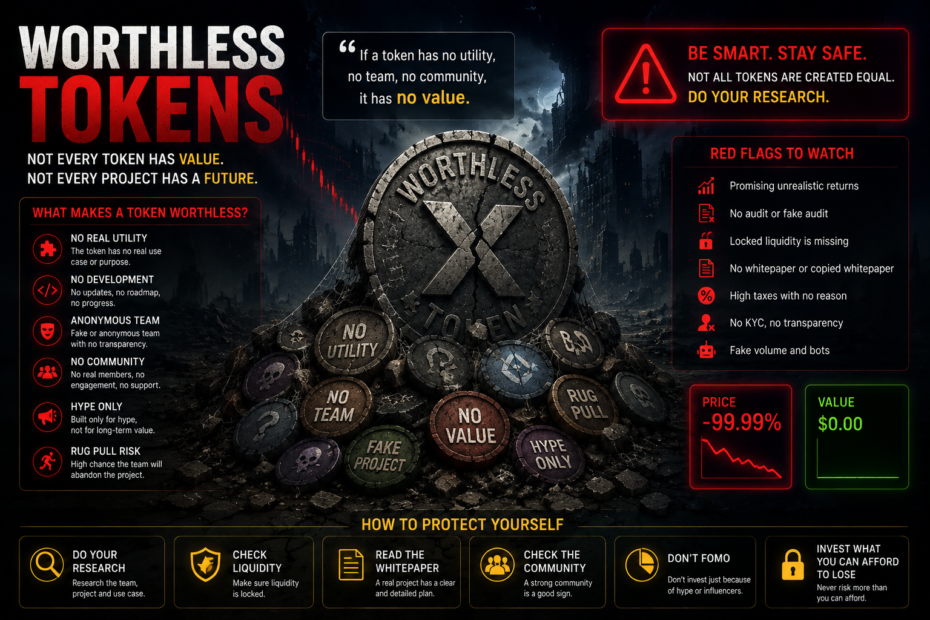
In crypto, a worthless token typically means a token with no real utility, value accretion mechanism, or backing – often created solely to defraud investors【27†L61-L68】【65†L174-L180】. Unlike traditional assets (bonds, stocks, commodities) whose “intrinsic value” derives from cash flows or physical utility, most tokens rely entirely on speculation and hype【27†L61-L68】【23†L74-L82】. Indeed, one investor-author notes that “99% of tokens have no intrinsic value” and are traded purely on speculative demand or artificial market-making【27†L61-L68】. Without value accrual mechanisms (e.g. revenue-sharing, staking rewards, or built-in fees), a token’s price depends only on new buyers. If growth stops – or if developers suddenly sell – the token can collapse to near-zero value.
Tokenomic frameworks distinguish “utility tokens” (used for fees, governance, or service access) from mere promotional or pyramid schemes【27†L73-L82】【23†L74-L82】. Crucially, value accrual matters: if a token does not entitle holders to a share of profits, fees, or produce new yield, its price is inherently fragile【27†L79-L88】. As one crypto analyst explains, tokens should have built-in yield opportunities (like fee distributions to stakers) to justify any price【27†L79-L87】. Without this, “buying a token is like trying to catch a falling knife” – its price is governed by hype, not fundamentals【27†L79-L88】. In contrast, tokens from genuine projects (e.g. Ethereum’s ETH, which secures its network and pays staking rewards) have clearer value drivers.
Unregulated markets and social-media hype amplify risks. Many worthless tokens are launched with glamorous narratives, celebrity or influencer marketing, or trending names (like the “Squid Game” meme token). As Crypto intelligence firm TRM describes: scammers create tokens with “flashy websites” and fake whitepapers to lure investors, then abruptly withdraw all liquidity, leaving holders with “worthless tokens”【65†L174-L177】. This common scam pattern is why tokens with no real use case and anonymous teams attract regulatory scrutiny.
Token Valuation and Tokenomics
Proper token valuation requires examining tokenomics: supply, distribution, utility, and incentives【27†L79-L88】【23†L74-L82】. Unlike stocks or bonds, tokens rarely represent cash flows, so their value must come from network usage or protocol fees. For example, decentralized exchanges might distribute trading fees to token stakers; Layer-1 blockchains can offer staking yields. Economic research proposes frameworks to categorize tokens by purpose (e.g. funding a project vs general currency)【25†L66-L75】. However, even academically, many argue crypto prices look more like bubbles than intrinsic value, since coins often lack underlying cash flows【25†L68-L77】.
Key tokenomics warning signs include:
- Unlimited Supply / Inflation: Tokens that can be minted at will dilute value. If developers retain power to mint or freeze tokens (a “honeypot” code), they can drain holders’ value【63†L161-L164】【70†L60-L68】.
- Unsecured Liquidity: Legitimate projects typically lock liquidity in smart contracts for a time. Unlocked or easily removed liquidity is a red flag【70†L49-L55】.
- Centralized Distribution: If a few wallets (often the devs’) hold most tokens, they can dump large volumes and crash the price【70†L68-L73】.
- No Real Utility: Vague whitepapers or purely “memetic” use cases suggest the token isn’t tied to any economic function【70†L83-L89】.
- No Audits or Verification: Reputable projects undergo smart contract audits. Lack of audit or failure to publish code review points to risk.
In short, the economic framework is simple: without user demand outside speculation (i.e. no fees, no yield), token value tends to zero in the absence of continuous hype. As one crypto analyst summarizes, “if a token has no way for holders… to earn yields, then it will only be bought and sold based on speculation”【27†L79-L87】. Many worthless tokens exploit this by promising rewards (governance rights, magic yields) that never materialize.
Types of Scams: Rug Pulls and Exit Scams
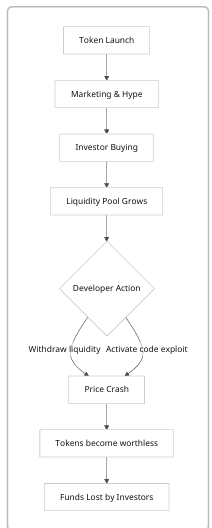
Rug pulls are the most notorious form of worthless-token scam. In a typical rug pull, project developers (who often control the token contract and liquidity pool) suddenly withdraw all liquidity or dump their tokens, causing the price to crash to near zero【65†L174-L177】【71†L159-L164】. Investors are then “subsequently left with worthless tokens” and no recourse【65†L174-L177】. As Hacken security reports note, scammers “create a token with an attractive name and promises… when the scam token price goes up… developers suddenly… steal all this fortune”, by removing liquidity or exploiting a backdoor in the contract【55†L146-L155】【67†L1-L4】.
Hacken categorizes rug pulls by mechanism:
- Liquidity theft: creators withdraw the entire DEX liquidity, collapsing price【55†L161-L170】.
- Sell-lock schemes: creators embed code so they can sell but buyers cannot (a honeypot), then later dump (soft vs hard rug pulls)【55†L161-L170】.
- Pump-and-dump: coordinated marketing and purchases pump price, then insiders sell off at peak【55†L169-L178】.
A blog by Solidus Labs emphasizes that rug pulls have become “the most common crime in crypto,” with over 300,000 scam tokens created and around 2 million investors defrauded【63†L141-L149】. In one example, the “Squid Game” token ($SQUID) skyrocketed 75,000% in a week and then immediately crashed to zero when devs withdrew all liquidity【71†L159-L164】【63†L170-L174】. Its creators made over $3 million before vanishing【63†L170-L174】. These are textbook cases of worthless tokens: the hype was built on a pop-culture theme, but the underlying token had no utility or locked value.
Exit scams and Ponzi-like schemes also produce worthless tokens. In some cases, developers promise trading platforms or “security token offerings” that turn out to be fake. For instance, the SEC charged operators of three purported crypto trading platforms (“Morocoin Tech”, “Berge Blockchain”, “Cirkor Inc.”) in late 2025 for a scam that defrauded investors of $14 million. Victims were lured via social-media investment “clubs” into these platforms, which offered fraudulent STOs purportedly backed by real companies. In reality “no trading took place… and the Security Token Offerings and their purported issuing companies did not exist”【33†L207-L214】. Investors who purchased these fake tokens were left with worthless entries on a trading site, not any real asset.
Another fraud style involves pump-and-dump of coins promoted by influencers (often anonymously). Scammers create a token, hype it on social media or celebrity endorsements, then dump their holdings. If victims hold on, they end up with essentially zero value as volumes collapse. Whatever the scheme, the end result is the same: after the scam, the token is largely or completely worthless, trading at near-zero price and with no backing.
Case Studies of Worthless Tokens
| Case Study | Year | Mechanism | Outcome/Loss | Source |
| Squid Game token ($SQUID) | 2021 | Honeypot scam: token contract coded to block sales; heavy marketing via social media. | Price spiked ~75,000%, then devs withdrew all liquidity in one transaction. Investors lost ~$3M【63†L170-L174】; token crashed to near $0; creators vanished【71†L159-L164】. | Solidus Labs【63†L170-L174】, Bitcoin.com【71†L159-L164】 |
| Fake STO Platforms | 2024-25 | Exit scam: Social-media “investment clubs” funneled $14M into fake crypto trading sites. | Platforms (Morocoin, Berge, Cirkor) claimed to list “security tokens” of real companies, but both platforms and tokens were fictitious. Funds were siphoned off; SEC seeks penalties. Investors’ tokens became worthless【33†L207-L214】. | SEC Press Release【33†L207-L214】 |
| Meme Tokens (e.g. SafeMoon) | 2021 | Pump-dump: celebrity-backed/tokenomics hype (e.g. huge dev tax). | Project sees a rapid run-up then persistent price decline. While some investors may exit, many holders are left with devalued tokens after central large sell orders. (Exact losses unknown.) | (Industry analysis, e.g. [27]) |
| DeFi Liquidity Hack (Uranium.Finance) | 2021 | Example: Automated exploit of liquidity pool vulnerabilities. | $50M drained from liquidity pools, tokens plummeted. Users left holding nearly worthless tokens after exploit. Developers vanished. | Security reports |
(Other scams abound – many meme coins, DeFi tokens, and “staking” schemes have gone rug as highlighted by crypto watchdogs【63†L141-L149】【70†L41-L44】.)
Common Red Flags and Detection Indicators
Detection Checklist: Investors and analysts use both off-chain and on-chain cues to spot potentially worthless tokens. Key indicators include:
- Unlocked Liquidity: If the token’s liquidity pool is not time-locked, developers can withdraw it at any time. An unlocked liquidity icon (e.g. on Dexscreener) is a major red flag【70†L49-L55】.
- Guaranteed High Returns: Any promise of “quick, big profits” or fixed returns is a known scam signal. The FTC warns that “only scammers will guarantee profits or big returns”【62†L403-L409】.
- Developer Control: Contracts that allow developers to mint unlimited new tokens or freeze user balances indicate honeypot functionality【63†L161-L164】【70†L60-L68】. If the creator address still owns owner or mint privileges, it should be treated suspiciously.
- Concentrated Token Holdings: A very uneven distribution (e.g. 80% of tokens in 2–3 wallets) enables price manipulation【70†L68-L73】. Blockchain explorers can flag when “whales” hold nearly all supply.
- No Audit / Obfuscated Code: Lack of a reputable third-party audit, or code that’s hard to read (e.g. tiny variable names, obfuscation) can mask hidden backdoors.
- Vague Utility / Whitepaper: Projects without clear, specific use cases (e.g. “it’s the token of the next big exchange”, or gibberish whitepapers) are suspect【70†L83-L89】. In particular, meme-coin projects often have nebulous goals.
- Community and Team Transparency: New tokens promoted by anonymous Telegram groups or only social-media hype (especially with little genuine Q&A) should be treated with caution. Legitimate projects have engaged communities and identifiable developers.
The table below summarizes some of these detection indicators:
| Indicator | Why It Signals Risk |
| Unlocked Liquidity Pool | Developers can remove all liquidity at once. Dex trackers show a “liquidity locked” icon when secure; no lock → high risk【70†L49-L55】. |
| Guaranteed Big Returns | Promises of fixed or huge returns indicate a scam. “Only scammers will guarantee profits”【62†L403-L409】. |
| Dev Mint/Freeze Authority | If devs control minting or freezing, they can create unlimited tokens or trap holders. Smart contract backdoors (e.g. 100% sell fees) are common in scams【63†L161-L164】. |
| Concentrated Token Supply | Large allocations to a few wallets (often devs) mean they can dump them and crash price. Blockchain analysis tools flag unusual wallet holdings【70†L68-L73】. |
| Unclear Utility | Vague whitepapers or AI-generated marketing graphics imply a lack of real product. Legit projects have well-defined use-cases【70†L83-L89】. |
These and other signs are discussed in crypto security blogs and analysis reports【70†L49-L55】【62†L403-L409】. Automated tools (e.g. TokenSniffer, RugChecker) and block explorers (for on-chain flows) can help apply these rules systematically.
On-chain Analysis Techniques
Because every crypto transaction is public, on-chain analysis can detect scam patterns. Researchers have developed methods to flag rug pulls by analyzing smart contract code and transaction graphs. For example, RPHunter (Wu et al., 2025) builds a “semantic risk code graph” (SRCG) from token contracts and a “token flow behavior graph” (TFBG) from transactions【57†L65-L74】【57†L99-L101】. It then uses machine learning to spot anomalies. In practice, this means looking for code features like honeypot traps or excessive owner privileges, and for trading patterns like abrupt liquidity drains or wash trading. By analyzing thousands of known rug pulls, RPHunter achieved >90% accuracy, and even discovered thousands of previously unknown scam tokens【57†L72-L79】.
In simpler terms, analysts may:
- Inspect the token’s smart contract on Etherscan/BscScan to see if the owner renounced ownership and if any “mint” or “blacklist” functions remain.
- Check whether the liquidity pool is irrevocably locked (via time-lock contracts) or not.
- Examine the transaction history: a sudden large transfer from the pool or a series of quick sells by one address are hallmarks of a rug pull【57†L55-L63】.
- Monitor holder counts: projects that gain 50,000 holders and then abruptly see 95% of holders leave in days are suspect.
The Mermaid diagram below illustrates a typical token lifecycle including a rug-pull scam:
Legal and Regulatory Responses
Regulators have taken note. The U.S. SEC and CFTC routinely issue alerts about crypto investment scams. In late 2025 the SEC charged scammers who used fake crypto platforms to defraud investors via phantom “Security Token Offerings,” highlighting that these STOs “did not exist”【33†L207-L214】. The SEC’s Crypto Assets Task Force continues to warn that many new tokens may be securities or outright frauds. Similarly, European authorities (ESMA/EBA) caution that “crypto-assets can be risky” and that investor protections vary by asset type【61†L244-L252】. They recommend checking whether the issuer is regulated and ensuring clear disclosures are provided.
In practice, law enforcement has prosecuted some rug pull cases, but often scammers remain at large. Victims have pursued civil suits and class actions (e.g. investors in collapsed projects like Basis, Bitconnect, etc.), but recoveries are limited. Table 1 (above) shows outcomes: often the best that happens is regulatory fines and demands for disgorgement【33†L207-L214】. This underscores that prevention – through diligent analysis and skepticism – is critical.
Prevention and Best Practices
To avoid worthless tokens and rug pulls, users should follow best practices:
- Due Diligence: Research the project team and tokenomics. Confirm identities of founders, check LinkedIn profiles, and see if code is published on GitHub. Projects like these should be treated as high-risk unless verifiable.
- Check Liquidity and Audit: Always verify liquidity pool locks on blockchain explorers. Look for independent security audits of the token contract. A lack of either is a major red flag【70†L49-L55】【63†L161-L164】.
- Small Commitments: Never invest more than you can afford to lose. Even legit projects can crash; shady ones will vanish. Spread risk across established assets rather than pumping into new tokens.
- Regulatory Compliance: Use reputable exchanges or custodians when possible. Check if a crypto service is registered (e.g. on SEC’s or FCA’s site). Fraudulent schemes often operate offshore or via unregulated social-media ads.
- Continuous Monitoring: If you do invest, keep alert. Sudden changes (locked funds, website disappearance, inactive social channels) may signal a pending rug pull. Early withdrawal (sell) when you see trouble can save remaining capital.
- Education: Recognize typical scams (as the FTC advises: only scammers demand crypto upfront and promise guaranteed profits【62†L403-L409】). Inform others in your community about scam patterns.
Finally, industry groups promote tools for automated detection (whale tracking, token-fraud filters) and advocate for standard disclosures. Smart contract code audits and proof-of-reserves can build trust; use projects that offer verifiable on-chain transparency. In regulated environments (e.g. under MiCA in the EU from 2024 onward), some issuers may be required to disclose whitepapers and risk warnings. Until broader regulation is in place, the onus remains on investors to apply scrutiny.
Conclusion
Worthless tokens – those without genuine value or utility – proliferate in crypto, often as part of scams or pump-and-dump schemes. Victims can lose everything when such tokens plummet, as illustrated by numerous recent cases. Understanding tokenomics fundamentals and remaining vigilant to red flags are essential defenses. By combining on-chain analysis (checking liquidity locks, contract code, holder distributions) with common-sense warnings (too-good-to-be-true returns, anonymous promoters), investors and platforms can reduce exposure. Technical measures (audits, smart-contract limits) and legal tools (enforcement actions, better disclosures) are increasingly applied, but no solution is foolproof. A skeptical, well-informed approach is the best safeguard.
Sources: Authoritative crypto and regulatory reports and research were used throughout. See citations above for SEC complaints【33†L207-L214】, fintech blogs【27†L61-L68】【55†L146-L155】, security firm analyses【63†L141-L149】【57†L55-L63】, and consumer-protection advisories【62†L403-L409】【61†L244-L252】, among others. Each section draws on these published insights to ensure accuracy and depth.